Subscribe


Stair Master: Climbing Stairs For Better Heart Health
August 19, 2026
As we noted in an earlier post, exercise is one of the most valuable activities you can undertake for your heart health. And while you might think cardio exercise is the most important physical activity for heart health, it turns out that a combination of cardio, strength training, and even balance exercises is critical for maintaining good heart health. Cardio or aerobic exercise gets your heart pumping and your blood moving to carry oxygen and nutrients throughout your body. It also lowers bad cholesterol, improves good cholesterol, and reduces your risk of diabetes. Aerobic exercise includes such movements as brisk walking, bicycling, swimming, or dancing. Strength training (lifting weights, using resistance bands, or using your body weight) can give you leaner muscle mass, which is important for lower cholesterol and lower cardiovascular disease risk. And by maintaining and improving your balance and stability, you will have what it takes to maintain a regular exercise routine. Exercise can benefit nearly every part of your body, and it can reduce your risk of cardiovascular disease by 25-30%. Unfortunately, estimates are that only 20% of adults achieve the recommended amount of both aerobic and strength training exercise. Furthermore, physical inactivity poses a substantial threat to your general health and your heart health specifically. This comes as the spectre of deaths from cardiovascular disease nearly doubled between 1990 and 2019.
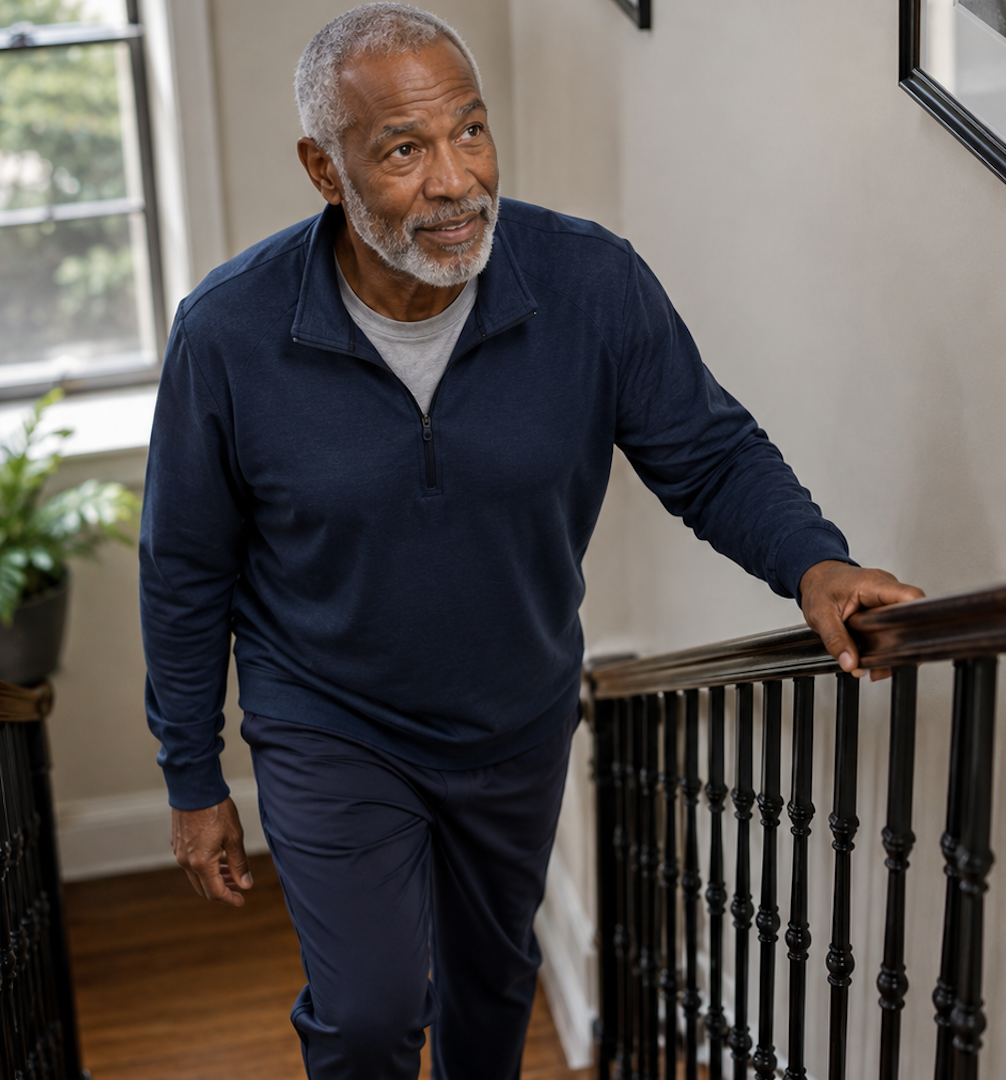
But for some of us, even fitting in a small amount of exercise doesn’t come easily. Maybe you’re busy, or lazy, or you have limited mobility, or you just hate exercising. Well, it turns out that a routine form of movement that many of us utilize during an average day may do just the trick for your heart and health. Prior studies suggested that by climbing stairs, you could lower your risk of cardiovascular disease. When climbing stairs, you raise your heart rate, work your lower body muscles, and build up your balance and stability, precisely the multi-form exercise that science has shown is most valuable for heart health. And now a brand new study published in The American Journal of Cardiovascular Drugs takes this research one step further. According to this new research, those who regularly take stairs have a 39% lower risk of dying from cardiovascular disease, and a 24% lower risk of death from any cause. This was a large study tracking over 450,000 people, aged 35 to 84, followed for a median of 14 years. The study participants self-reported their daily stair-climbing, and it appears that climbing 6 flights of stairs a day was the ideal in terms of health outcomes. While this is not proof that stair climbing can prevent cardiovascular death, there was nonetheless a strong and consistent association between stair climbing and a lower risk of such death and, more broadly, all-cause mortality. At a minimum, this research underscores the important knowledge we have about the relationship between physical activity and cardiovascular health, and stair climbing is an easy way to ask most adults to enhance their aerobic and strength training exercise in one fell swoop.
But we don’t want to minimize the effort it takes to climb stairs. Every time you take a step, you are moving your entire body against gravity, thereby making your heart and lungs work harder in short bursts. And if your breathing feels a bit labored or if you feel slightly out of breath after you take a flight of stairs? This is probably a normal physiological response and no cause for concern, unless your breathlessness lasts longer than a few moments, or you feel other symptoms such as chest pain or headaches. While it’s always a good idea to consult your primary care physician about new exercise routines, including becoming a stair “master,” there are ways you can improve your strength and endurance to make stair climbing easier for you and a better workout for your heart. A recent post from The Today Show suggests 5 exercises you can practice to better train your leg muscles for stair climbing, including sit-to-stands, calf raises, and marching in place. Or, you can take a look at a recent routine from our friends at Yes 2 Next, who have created a workout focused on your hips and glutes for easier stair climbing. There’s no pressure to force yourself to speed up stairs- a slow and steady climb still gets you the valuable physical movement your body needs, and of course, we want you to stay steady and safe. But if you’re not sure how to sneak in more daily exercise, and you have the opportunity, then work those muscles along with your heart and take the stairs the next time you have a chance.