Subscribe


Balance Your Body: Better Balance For Fewer Falls
April 29, 2026
You might think that with the nicer weather and you being out and about more, your risk of falling and injuring yourself is less than in the cold and icy winter months. Certainly, more walking and physical activity are good for strengthening your leg and foot muscles. But it’s just as easy to trip and fall due to such spring “hazards” as uneven sidewalks, wet pavements, or even garden hoses. And even if they feel like “minor” mishaps, falls in older adults frequently lead to serious complications that can cause immobility, loss of independence, and even premature death. While younger adults may catch their foot on an uneven sidewalk, the same misstep in an older adult can quickly devolve into a traumatic occurrence. You don’t even have to fall from a great height to cause a hip fracture or pelvic fracture that can spiral down into a hospitalization, immobility, uncertain rehabilitation, and even cognitive decline. Calling a fall more dangerous than most cancers, The Substack Forever Young recently warned that adults age 70 and above are 3 times more likely to die from a ground-level fall than adults under age 70. So, in the blink of an eye (or the stub of a toe), you can be on the ground and headed for big trouble.
There are numerous reasons why an older adult’s fall can be more catastrophic than that of a younger person. With weaker muscles, thinner, more brittle bones, less fat padding, and medications that can cause excessive bleeding, among other things, a tumble to the ground can just cause more damage, not to mention that the healing process is more arduous in an older adult. As well, according to a recent study published in eNeuro, when you have a balance disturbance as an older adult, your brain and muscles can actually go into overdrive, taking away the energy and engagement to easily maintain or adjust your balance. Not only does your brain become overactive, but your muscles may stiffen, leaving you less able to recover your balance. Even without falling, wobbly balance as an older adult can reveal many potential health problems, including weaker signals between neural pathways, core instability, weak or stiff joints, and vestibular (inner ear) problems (especially if you experience dizziness or vertigo). A recent post from AARP also outlined a series of surprising causes of balance problems in adults over 50. Fortunately, for many, if not most of these possible challenges, there are exercises or other interventions that can help address these issues and improve your balance.
Of course, before you start exercising, make sure you clear the hazards not just around your home but inside as well. As we’ve previously mentioned, tripping hazards, poor lighting, and insufficient supports around the house (such as grab bars, stair rails, and easier-to-reach everyday objects) can all undermine your steadiness and leave you at risk for a fall and fracture at home. A recent New York Times article on Preventing Home Falls provides a good review of how to improve your balance prospects when inside your home.
And onto exercise: Several recent exercise posts and videos provide ample support for the idea that with just a little effort, you can significantly lower your risk of a fall. For those who like to dance, a recent post in The Conversation pitched dance as “exercise in disguise” that not only uplifts your mood and puts a spring in your step but can also be an ideal form of balance training, even if your lessons are online over Zoom. Specifically looking at simple exercises to do on your own, several recent posts in Fit& Well suggest some daily easy-to-implement exercise routines that require modest time and effort but result in big balance improvements. So, for example, Australian physical trainer Heath Jones has a series of 5 recommended exercises (with video illustrations) that require little equipment, mirror your daily functions, and will get you moving with better balance and less fear of falling. Another trainer makes it even easier with just 2 simple lower-body exercises to lead to strong, responsive feet, which are essential to prevent a fall. This 5-minute-a-day routine (with video illustrations) may be all you need to stay steady and upright. For a more comprehensive and robust strategy for improving your balance, our friends from Yes-2-Next recently conducted a 15-day challenge for better balance. You can watch all 15 of these videos here.
Finally, for those inclined, the National Council on Aging and US News both recently posted their recommendations for the best fall prevention and detection technology available in 2026. US News even created a chart helping you consider which technology is right for you, which we share below. So do some self-assessment and decide whether an additional alert system will provide you with the extra security (and comfort) you need to confidently go about your activities without fear of falling.
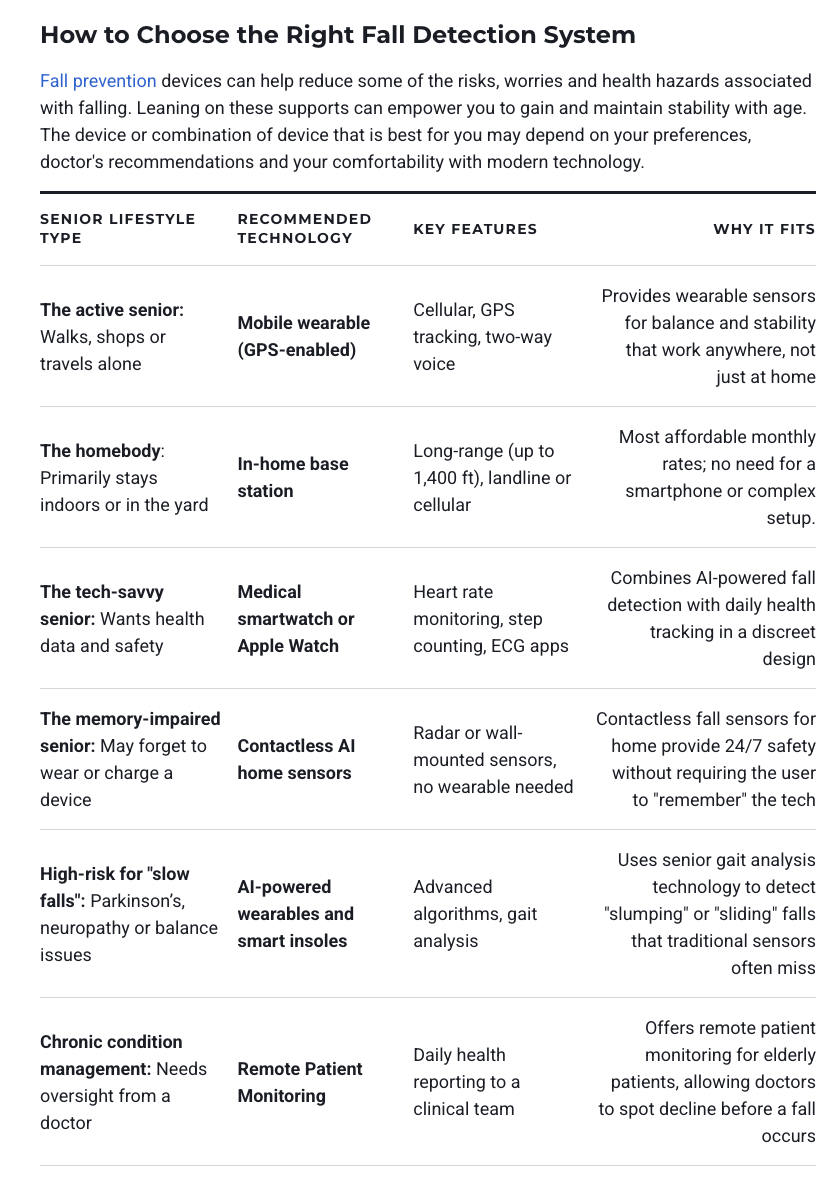
(From US News, Top Fall Prevention Technology for Seniors 2026: AI & Wearables, March 31, 2026)