Subscribe



Seniors Getting Scammed: Rising Rates of Fraud Continue To Trap Older Adults
October 28, 2026

It seems like there is no place left in your life that you can hide from scams. Whether it’s figuring out your Medicare plan, using your credit card, doing your banking, or even getting a summons for jury duty, scams, with a heavy assist from AI, have now infiltrated virtually every aspect of daily life. A recent report from the Federal Trade Commission bears this out. According to this new report, older Americans in particular are losing billions of dollars each year to scams, and the theft continues to grow every year. Estimates are that in 2025, older adults lost $3 billion to scams, up from $600 million in 2020. Investment scams top the charts, with older adults falling for fraud connected to social media schemes and phony phone calls, with fake tech support scams and bogus prize offerings draining older adults of millions of dollars. In many fraud categories, older adults are much more likely to lose their money than younger people. Why is that? Smart fraudsters know that older victims may be more vulnerable due to frailty, poor sleep, or hearing or vision loss, and they may be more emotionally vulnerable to the ploys of schemers. Furthermore, older adults are likely targeted because they are in better financial health than younger people, and with the social isolation that affects many seniors, scammers know there are fewer contacts to persuade an older victim that they are falling for a scheme.
So what are some of the examples of the latest schemes luring in their older victims? With the current Medicare Open Enrollment now going on, you can be sure that fraudsters are looking to lure in as many unsuspecting older adults as they can. What are some of the schemes? With fake government identifications, they may fool you into thinking you need a new Medicare card or a possible genetic test courtesy of Medicare, or they may threaten to cancel your coverage, all in an effort to put you under pressure to reveal important information, including your Medicare number (which is now considered the equivalent of having someone’s credit card number to commit fraud). Estimates are that in May 2026 alone, Medicare impersonation scam calls reached over 7 million Americans. But there are ways to be on guard and to be aware of when you may be the victim of a scam.
For example, take a look at these recommendations, as spelled out by the Federal Trade Commission:
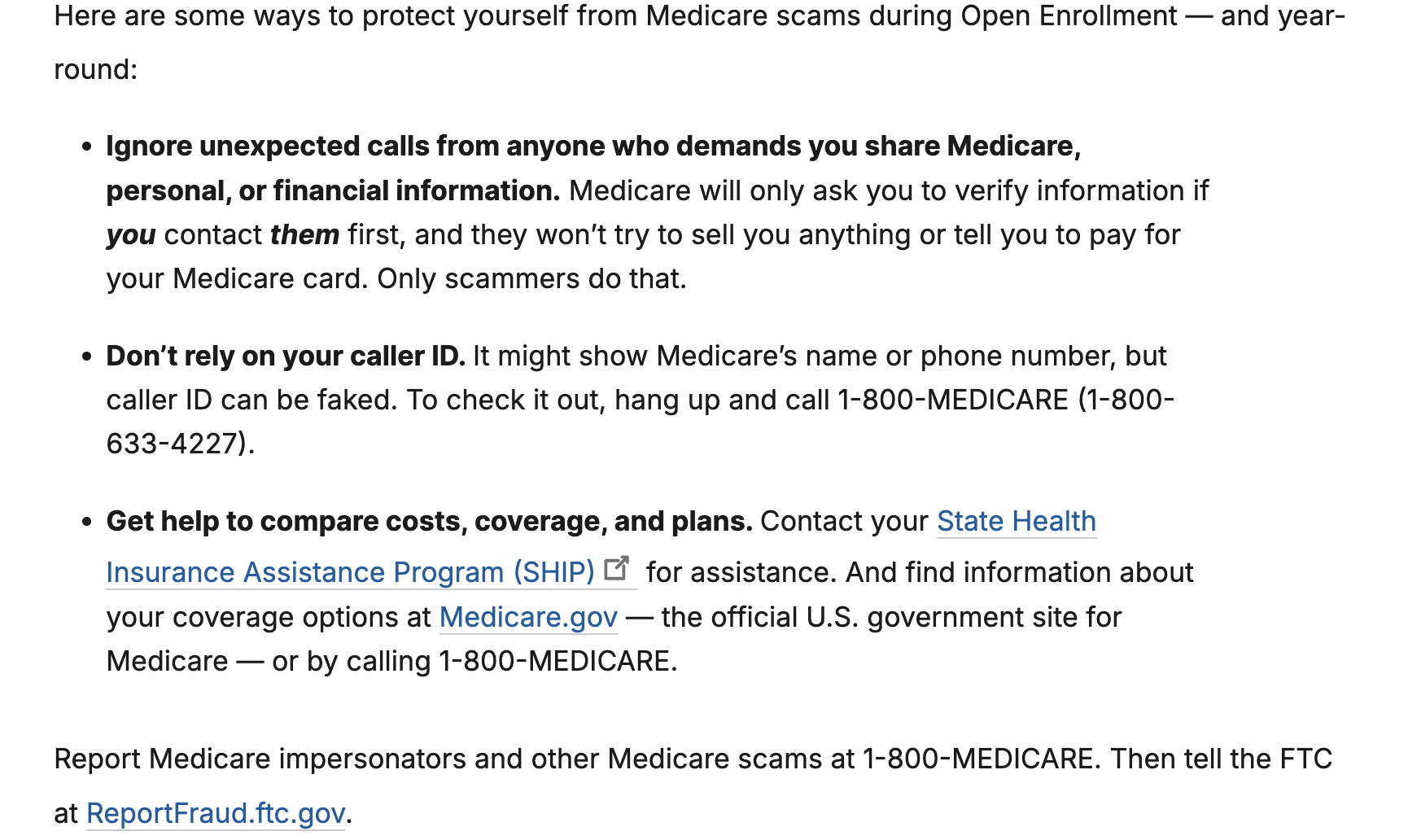
There is also a new scam going around, having to do with the patient health portal MyChart, coming through texts and emails, trying once again to get your Medicare number in “exchange” for a special (and fraudulent) kit. Even though the messages appear to be legitimately from Medicare, the reality is that nothing like this is being sponsored by Medicare, so don’t give out personal information or go along with recommendations that you replace your Medicare card. For help with a suspected Medicare scam, cover your card and click here.
There are also ongoing scams involving credit cards and banks. Scammers now have the capacity to make their outreach appear as though it is from a legitimate financial institution. A recent article in The Atlantic outlined how easy it is with AI to create realistic-looking images or financial statements, making it more difficult for banks (or other institutions such as hospitals or government agencies) to proactively prevent fraud. For example, using AI, it’s now very easy to create a realistic check or wire-transfer alert.
Warning signs about what may be a scam from someone purporting to be your bank would include suggestions that the FBI is involved in investigating, requests are being made to move money to “protect” it, or pressure is being put on you to act urgently and quickly. In fact, if you have any suspicions, even if the caller ID looks legitimate or the email appears to be coming from your bank, you are urged to take a step back, hang up or delete, and directly call your bank (using a phone number you know is legitimate) to investigate if, in fact, there is a problem.
Scammers are also using a technique called “email bombing,” where they flood your inbox with hundreds of emails to try to overwhelm or confuse you, or to cause you to neglect to see a legitimate email sent by your bank warning you of a scam. The Washington Post recently ran a story about this stunt, which often includes outreach by fraudulent “tech support” assistance to help you sort through the storm of emails now sitting in your inbox. If you are the victim of this email bombing, take that as a signal that something is amiss, and call your financial institution immediately to determine if some sort of scam has been perpetrated.
Perhaps the craziest and newest scam has to do with false assertions that you have missed your jury duty service and a warrant has been issued for your arrest as a result. The Wall Street Journal recently described the horrifying saga of a Florida woman who was scammed out of tens of thousands of dollars because of fear that she would be arrested due to her “missed” and then no-show jury duty service. Again, using threats, a sense of urgency, and official-looking language and documentation, it would be easy for someone who is a responsible citizen to be scammed into thinking that they may face arrest. So be alert, be on the lookout, and find out more here.