Subscribe


Protect Yourself: Expert Medical Groups Recommend Fall Vaccines
September 16, 2026

As kids head back to school, activities begin to move inside, and holiday gatherings begin to pick up speed, it’s virtually guaranteed that you will be exposed to some nasty viruses. Whether they are just a nuisance or instead turn into a serious medical illness may be determined by your level of vaccine protection. While vaccines don’t entirely eliminate the risk that you will become infected, they do dramatically lower the risk that you will become seriously ill. So what vaccines should you be preparing yourself for as we head into the second half of September and then onto the remainder of the fall?
Earlier in August, we highlighted the new mRNA flu vaccine that has been developed, using technology first introduced during the COVID pandemic. Millions of lives were saved as a result of using this technology to develop a COVID vaccine in record time. Whether this new mRNA flu vaccine is available for us this fall (it’s been FDA-approved for adults aged 50 and above) remains uncertain. While the manufacturer Moderna has said the vaccine will be available for the 2026-2027 flu season, it’s unclear exactly how much vaccine they will produce this first time, and whether it will be more expensive than the usual flu vaccines, or whether demand will be dampened due to misinformation about the use of mRNA technology for the COVID vaccine. It does not appear that any of the major pharmacy chains are currently offering the mRNA flu vaccine, and the advice is not to wait for it: You are better off taking one of the regular flu vaccines (preferably a higher-dose flu vaccine if you are over 65) than delaying as the flu season approaches in full force. Regarding predictions for this year’s flu season, so far, flu activity remains low, especially in comparison to COVID activity (which appears to be picking up, according to wastewater tracking). Last year there was significant flu activity (one of the worst flu seasons in decades), but clues for this year suggest things may not be as bad. In the Southern Hemisphere, it’s been a moderate flu season to date, and so far, unlike last year, there is no evidence of a new flu mutation that previously led to a significant number of new cases. Flu season generally peaks in the US from December to February, but the vaccines take a few weeks to kick in, so you are generally advised to get your flu vaccine in late September or early to mid-October.
In addition to flu, there is COVID and RSV, the two other respiratory viruses that begin seriously circulating in the fall. The news about all of these viruses may be confusing, and for good reason. The CDC, in consultation with its Vaccine Advisory Committee, usually issues recommendations every fall, instructing state health departments, pharmacies, physicians, and insurance companies about vaccines. This year, however, such recommendations from the CDC have not come through, and its Vaccine Advisory Committee is in chaos. So, into the void of no CDC expert recommendations has come a series of recommendations by a multi-group body of experts who have issued vaccine guidance for all populations in the US. These recommendations were developed by the independent Vaccine Integrity Project, working with the American Medical Association. As the experts make clear, “Influenza, COVID-19 and RSV are expected to send hundreds of thousands of Americans to the hospital this fall. COVID-19 is causing less severe illness overall than it did earlier in the pandemic, but all three viruses continue to pose a serious risk, particularly for older adults, young children, and people with underlying health problems.” It is simply unconscionable that expert recommendations were not forthcoming this year, and thus, the American Academy of Pediatrics, the American Medical Association, the American College of Obstetricians and Gynecologists, the American Academy of Family Physicians, and the Infectious Diseases Society of America have all come together to put forth the recommendations that follow:
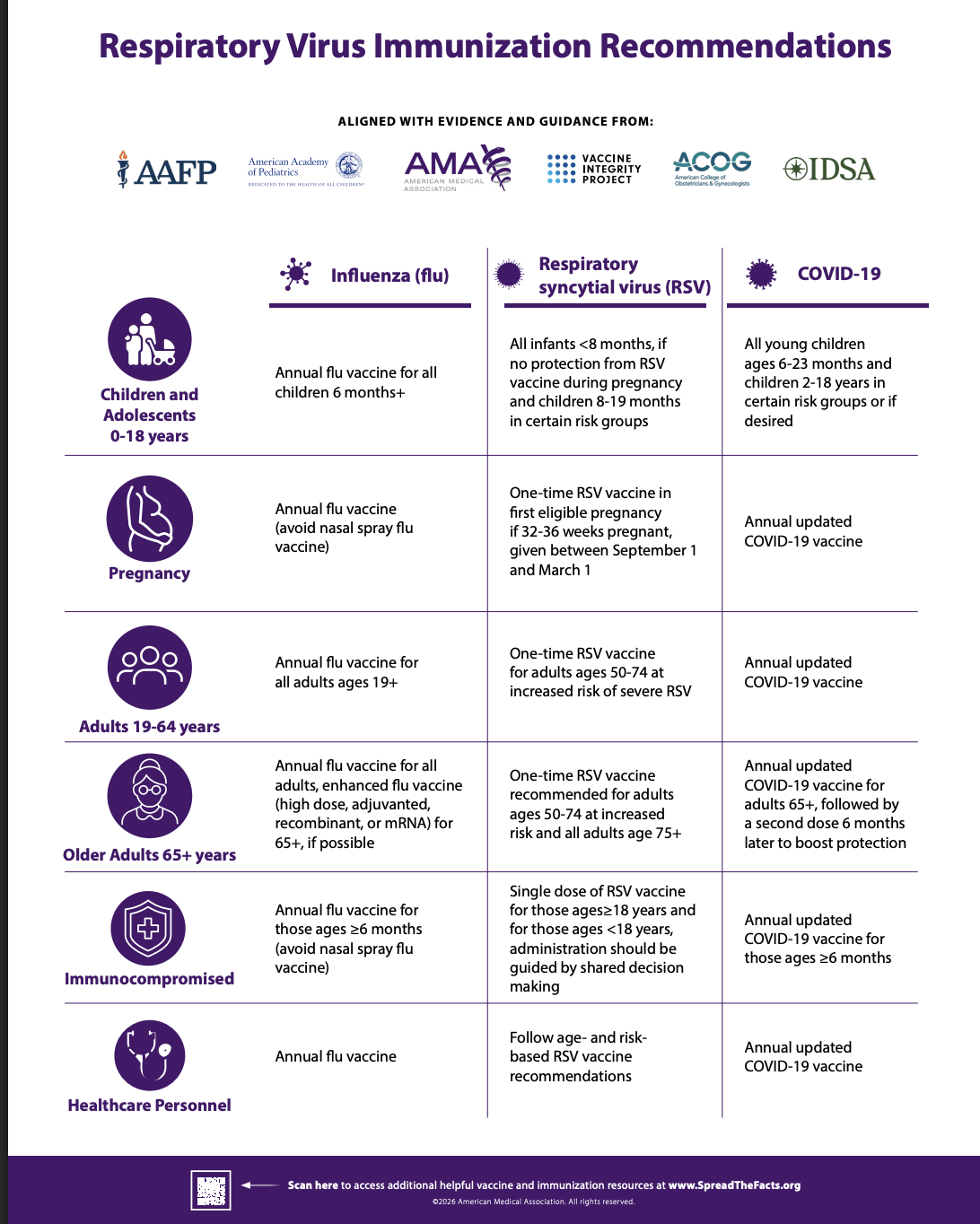
With specific regard to this fall’s COVID vaccines, the FDA approved an updated vaccine in August, and Moderna and Pfizer have already shipped the updated vaccines, which should now be available at your local pharmacy or physician’s office. The shot is approved for all adults aged 65 and older, and for those under 65, if you have an underlying condition that puts you at risk of severe illness from COVID, you are eligible for the vaccine. Many, if not most, pharmacies should allow you to self-attest that you are eligible for this category, though some may require a physician’s prescription.
Despite the misinformation and mistrust among some about these vaccines and their safety, there is no mistaking the toll these viruses can take, particularly among those who are unvaccinated. As the American Medical Association reports, “According to interim CDC estimates, during the 2025–2026 respiratory virus season there were at least 390,000 influenza-related hospitalizations and 24,000 deaths. RSV—which puts infants and older adults at greatest risk—caused an estimated 2.8 million to 5.8 million outpatient visits, between 170,000 and 340,000 hospitalizations, and as many as 25,000 deaths. And while the severity of COVID-19 has thankfully lessened since the early days of the pandemic, in the last respiratory virus season, SARS-CoV-2 was linked to between 4.6 million and 13.1 million illnesses, between 140,000 and 250,000 hospitalizations, and between 15,000 and 43,000 deaths in the United States.” It’s clear: Now is not the time to be timid or cowed by misinformation about the benefits of vaccines. Now is the time to roll up your sleeve and get protected- for yourself, for your loved ones, and for your larger community.