Subscribe


Openings And Closings: Strategizing About Medicare Open Enrollment Season
October 14, 2026

As predictable as the arrival of shorter days and cooler weather, October also signifies the start of Medicare Open Enrollment season. Experts advise that you carefully review your current coverage as well as your anticipated health and medication needs for the coming year, and check whether your current plan (with whatever changes are being made for 2027) will meet those needs. This year it’s especially important both to review the Annual Notice of Change from your current plan about what it will offer next year and to carefully read what you can about other options: what premiums will be instituted, what deductibles you may have to meet, what copays will be required, what drugs and pharmacies will be part of their formulary, and what limitations they have on providers you can see and approvals you will need for care. The market is, in many ways, reacting to new constraints and new incentives, and as a result, you, the Medicare consumer, might be setting yourself up for greater medical expenses if you’re not careful. If you do nothing and don’t consider your options, that may cost you unnecessary expenses. And some Medicare consumers will likely have no choice but to pay more for their care in 2027.
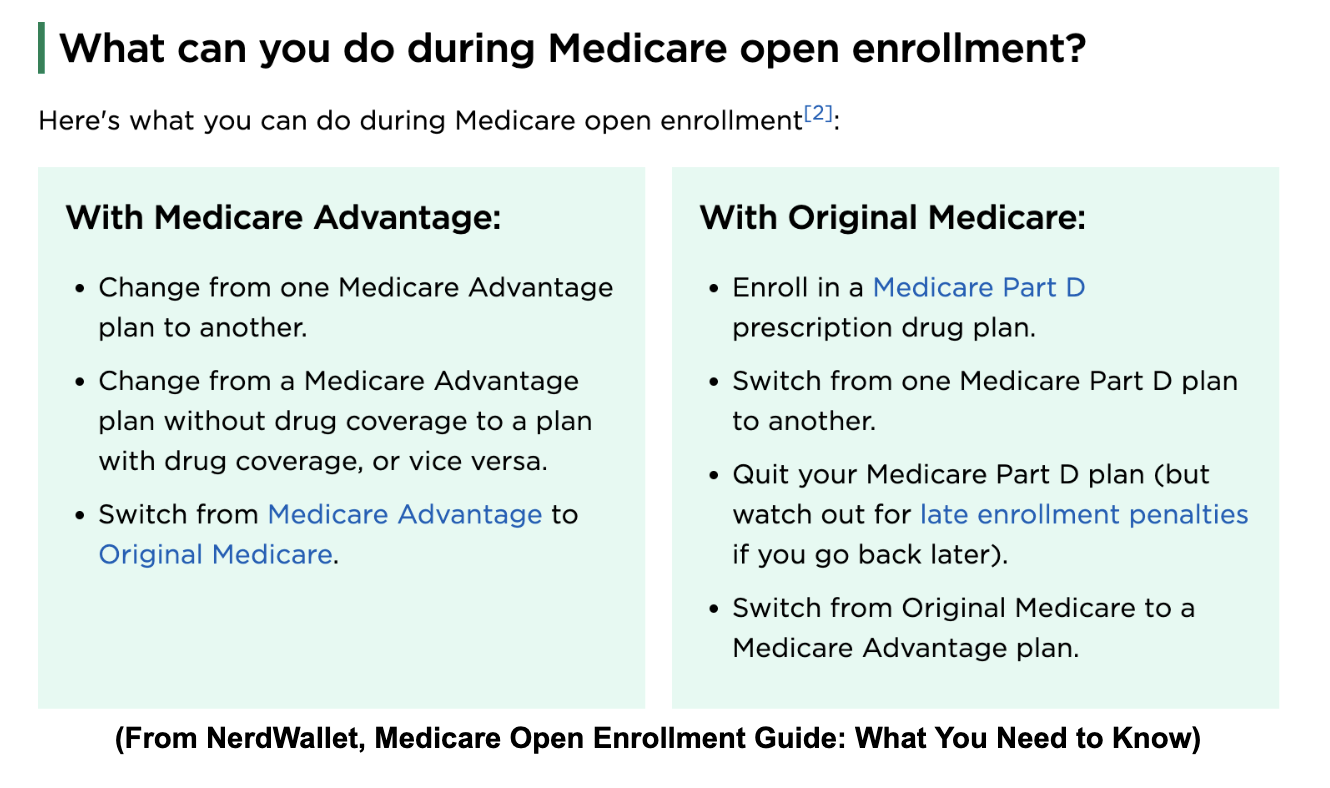
Close to 70 million Americans use Medicare to pay for their health care costs, and from October 15- December 7th, Medicare recipients can switch to a Medicare Advantage plan, or those already on Medicare Advantage can switch to a different plan or even back to Original Medicare. And if you switch from an Advantage plan back to Original Medicare, you will also have the option of choosing a new Medicare Part D prescription drug plan, and you may be able to purchase a Supplemental (Medigap) plan for costs not covered by Original Medicare. So, depending on your current plan and your selections going forward, there are many options to consider and many potential pitfalls in terms of costs of care and providers available to you. For a trustworthy and comprehensive review of the enrollment period and how to think about your options, take a look at the Kaiser Family Foundation’s Medicare Open Enrollment and Coverage Options: Key Questions and Answers. You can also consider some of the important questions raised in a recent US News interview with a Medicare expert.
There are some very specific changes happening in the Medicare Advantage market this year that you also need to be aware of. CMS states that 99% of Medicare beneficiaries will have access to at least one Medicare Advantage plan, and 97% will have access to 10 or more plans (there are a total of about 35 plans on the market for this coming year). They also state that premiums for these plans will be stable or even slightly less than last year. However, while premiums may be stable or even slightly less, other costs, such as deductibles or co-pays, may rise, making it ultimately more expensive to have a Medicare Advantage plan, even with the extra perks and benefits these plans provide (and many plans are cutting back on some of their perks as well). While estimates are that 80% of current Medicare Advantage beneficiaries will be able to remain with their current plan if they want to, that still leaves millions of Medicare recipients in a lurch, given that about half of all Medicare beneficiaries currently have a Medicare Advantage plan, rather than using Original Medicare.
Millions of those currently on a Medicare Advantage plan will have fewer options for the coming year, as private insurers begin to pull back from some regions, especially those in rural areas. Those pulling back on their offerings include some of the major Advantage plan providers, including United Health, Humana, Centene, and Health Care Service Corp. While nationally there’s still a fairly robust market for Advantage plans, in individual communities it might be quite another story. According to a brand-new New York Times Investigation, millions of older adults whose plans are no longer considered profitable by insurance companies will have fewer, if any, choices of plans going forward, and likely less access to providers along with higher prices. The Times reports that estimates of as many as 5 million current Advantage participants will be forced to switch plans because their current policy has been cancelled or is no longer available in their geographic area. States like New Hampshire, North Dakota, Oklahoma, and Alaska are being hit by these closures. If you are losing your Medicare Advantage plan, you should have received a non-renewal notice from your insurer. If you switch back to Original Medicare, you will likely need to pay for a Medigap Supplemental policy, although a new analysis by the Kaiser Family Foundation found that nearly 3 in 4 Enrollees in Medicare Advantage have a pre-existing medical condition that could trigger a denial for a Medigap Policy if they switch to Original Medicare and seek supplemental coverage.
If you switch back to Original Medicare, you will also likely want to purchase a Part D prescription drug coverage plan, which is also run by private insurers. Even if you currently have Original Medicare and a Part D plan, you will also want to carefully review the upcoming changes for that drug coverage plan, given that insurers are competing for your business, so prices may vary from one plan to another. While it’s useful to look at monthly premiums, you also want to consider such factors as pharmacy networks, formularies, and deductibles. In addition, because the Trump administration ended the temporary Federal program that subsidized Medicare Part D insurance premiums, it’s estimated that about 25 million Americans could see their prescription drug coverage get more expensive in 2027.
For those of you hoping to receive the $90 payment that the administration promised to Medicare recipients, be advised that the payments are only intended for Original Medicare beneficiaries to help with Part B expenses. Those in Medicare Advantage plans are not eligible for this one-time payment. The money for this plan comes from the Medicare Improvement Fund, intended for a different purpose and now essentially wiped out because of these one-time payments. The $90 payment should be directly deposited into your account.
For additional questions or help with this year’s Open Enrollment, you may want to check out the Medicare website’s review of 2027 plans or contact your State Health Insurance Assistance Program (SHIP), which promises one-on-one counseling from an unbiased source.