By Mary Fridley
I am pleased to share an edited excerpt of an article, “Emotional? Yes. Tragedy? No. My mom, Tom Kitwood, and me,” that was published on LinkedIn last month.
While I’ve chosen not to include in this post the sections about Tom Kitwood, I hope this quote from Lynn Casteel Harper (“Speak, Memory,” Sun Magazine) will give you a sense of why he’s become a source of inspiration (though I also hope you’ll read the full article, where you’ll also learn more about “dementia ensembles”).
“Tom Kitwood was a social psychologist in Britain who did a lot of research on people living with dementia. He was going into care homes in the 1980s and 1990s, and he came to realize that the environments in which these people lived were profoundly stigmatizing and might actually have accelerated their decline. He noted the interactions they experienced throughout a day, and he labeled seventeen malignant things that happened to them, such as infantilization, being ignored, being banished. He said it wasn’t about the malice or ill will of individual caregivers. It was part of the air we breathe.”
The full article published on LinkedIn is available here.
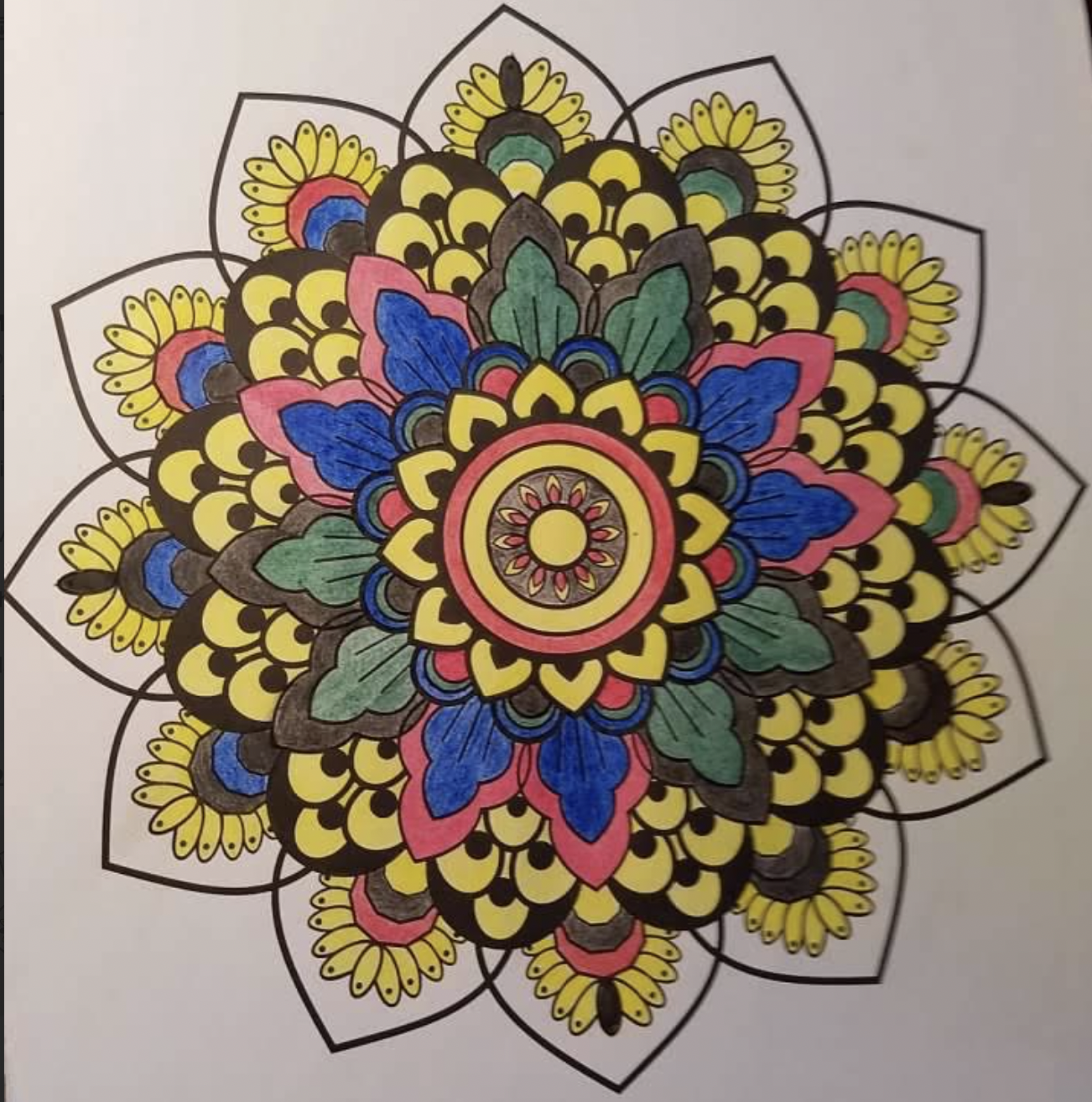
Finally, a special shout-out to my mom, Almeta Fridley, for creating the mandala that serves as the graphic for this article – watching the care she took in creating it was joyous.
*******************************
It wasn’t supposed to be like this / Said simply No lament of pity Though many tears.
These are the first lines of a poem I wrote the day my mom, Almeta Fridley, realized she would not be leaving the Austin, Texas-based nursing home she’d entered after a series of strokes resulted in a fall from which she never cognitively recovered. While we were decorating her room with the pictures and artwork my mom most loved, she said, “Oh, those are too nice for this place. You should take them home.”
It was then that I told her that “this place” was now her home. My mom didn’t cry easily, but at this moment, she sobbed. At other times, I might have “toughed it out,” not wanting to add to her grief, but on that day, it felt cruel to pretend the sorrow was hers alone. So we cried together.
Afterwards, while sitting on a bench together, she quietly said, “It wasn’t supposed to be like this.” I was heartbroken, and every time I say or write these words, I tear up. Because she was right – her children had failed her. We knew she never wanted to end up in institutional care, and yet we put her there, because none of us wanted/were in a position to do otherwise.
I say this more out of candor than guilt (though it’s there). As is often true for children caring for parents, she and I long had an uneasy relationship. In all honesty, I don’t think she knew what to make of me. Though I didn’t come out until my early 20s, it was pretty clear I was a lesbian or, at a minimum, not traditionally feminine (a “tomboy” as we used to say). Femininity was important to my mom, which was fine. The hurt and pain came with the blunt and often demeaning way she expressed dissatisfaction.
In the last years before she died, she and I did grow closer. We were both open to going beyond the constraints of “family” and creating our relationship anew. As it turned out, we both liked the people we were becoming and the relationship we were developing. Among other things, I was able to appreciate how smart, playful, and artistic she was. Could she still push my buttons? Oh, yes! In this, Almeta Fridley had no equal.
As her cognitive decline became more pronounced, friends would ask me if she “still knew me.” My honest response was, “I don’t know, nor do I particularly care.” I wasn’t trying to be glib, but she and I hadn’t really known each other for most of our lives, so it felt hypocritical to relate to this new moment as dramatically different.
This said, our journey was far and away the most emotional of my life. As her primary, long-distance care partner from New York City, I experienced every feeling possible. There were days when frustration, grief, love, exhaustion, fear, anger, and tenderness came crashing together, times when all I could do was cry.
And I’m grateful, because this journey also taught me something essential: no matter how emotional I was, no matter how soul-shattering the experience could be – and it can be – dementia is not a tragedy. Not in the sense that it involves only pain and no possibility. I understand why it can be hard to see possibility. It’s not something we can experience alone.
Possibility is something we create with whoever is around us, including the people we’re caring for. Might what they have to give be different? Yes. But so can our ability to accept, if we learn to see it as an “offer” with which we can be even a little more playful. And maybe, as an opportunity for caring for and caring with to be inseparable.
For example, when my mom lost her ability to speak in ways unrecognizable as English, she began moving her hands in beautifully balletic ways. I was especially touched when I saw this smoker of sixty-plus years raise her hand to her mouth over and over again, so I joined her in creating a slow-motion “smoker ballets.” I was also deeply moved by the exquisite intimacy with which she “spoke” to anyone around her, including those visible only to her.
And we were surrounded by a wonderfully rag-tag community of support (a dementia ensemble – more on this later). Oh, and I made sure to share everything I was feeling with friends (actually, with anyone who would listen).
I’ve been asked if it would have been more difficult if she had responded with more agitation or hostility. I have no doubt. Though I have every confidence that I would’ve organized the support necessary to continue responding with the same spirit of creativity, radical acceptance, and collaboration.
The environments we create matter!
Dementia is not easy on anyone. But as friends and colleagues living with dementia have told me, it is the environments they’re surrounded by – which run the gamut from ignorant and patronizing to abusive and life-threatening – that do as much, if not more, damage than the condition itself.
But why would anyone thrive if told to “go home and die”? Or told they don’t “really have dementia” because they’re so “articulate.” Or related to as consumers/clients rather than as creators of both art and life? Or dismissed as victims with no meaningful say on issues of money, sex, death, and more?
Then again, it’s also hard to thrive in unhappy homes. Or in jobs that we hate. Or in classrooms and other learning environments that are rote and boring. Or in conversations and relationships where assumptions prevail and no one really listens. In other words – and on this I am confident Tom Kitwood would agree – coming together to create “non-knowing growing” environments really does matter!
Being afraid together
What did creating a dementia ensemble look like for me and my mom? It meant inviting everyone who had a relationship with us to be part of the journey and to give what they could. And believe me, it was everyone, including her primary care partner (who my mom loved like a granddaughter), her actual granddaughters, my siblings, and a woman who hung out at my mom’s house as a child.
We also welcomed her primary care doctor, social workers, and aides at the care home, friends in Austin and New York, relatives across the country, and anyone else – even relative strangers – who wanted to join us. We made it up as we went along, supporting each other to laugh, cry, make mistakes, be frustrated, and have fun.
We were also afraid together – and when fear went from “mine” to “ours,” we had a much better shot at, as a colleague so beautifully said, “…lifting a once private burden and giving everyone the room to breathe again.”
In closing, I invite you to experience the power of play, performance, and creativity. Which, as many are now discovering, is as “curative” as any pill ever produced or course ever taken. And as revolutionary in its humanity as our world needs – and deserves.
Mary Fridley is on the faculty at the East Side Institute in NYC, co-creator and leader of The Joy of Dementia (You Gotta Be Kidding!), and coordinator of Reimagining Dementia: A Creative Coalition for Justice. An accomplished teacher and workshop leader, Mary practiced social therapy for 12 years and uses the social therapeutic approach as a teacher and workshop leader. She is the author or co-author of several articles and chapters on the Joy of Dementia, including a chapter that appears in The Applied Improvisation Mindset, published in August 2021. Additionally, Mary is a guest blogger for agebuzz and a playwright and theater director. She makes her living as a non-profit fundraising consultant. She can be contacted at [email protected]




Sign up for agebuzz’s free weekly newsletter sent every Thursday
 Subscribe