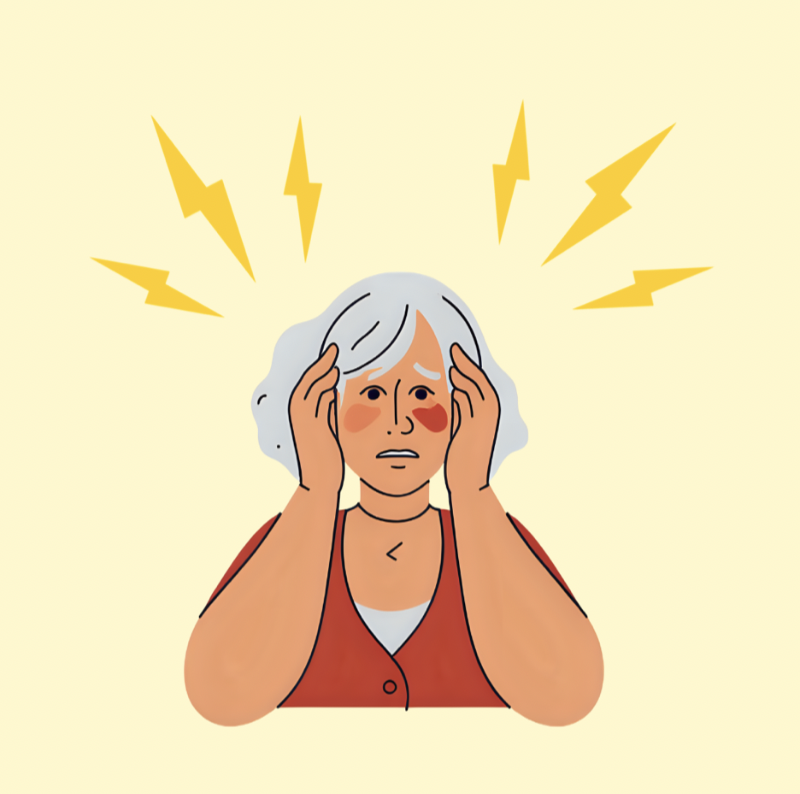
I had hoped that the headaches would stop after menopause
By Nancy Peckenham
Four days after my 70th birthday in March, my health took a deep dive south. I awoke with a headache, a familiar band of steel squeezing my skull. I’ve had recurring headaches for 50 years – eye pain, sleepiness, irritability – an invisible force twisting the tourniquet ever tighter around my head.
These headaches have come and gone over the course of decades, lasting several days at a time. I’ve been seen by neurologists, biofeedback therapists, Alexander Technique teachers, nutritionists, massage therapists, acupuncturists, and a spiritualist. Some drugs brought temporary relief. Biofeedback taught me how to relax the muscles in my neck and back that had tightened due to pain. Staying away from certain foods, including gluten, seemed to make the periods between episodes get longer.
For a year in my late 60s, I didn’t have a single headache. I thought I was free – hormonal changes in post-menopausal women can eliminate headaches, and I dared to hope they were over for me — then bam! The headaches returned and stayed longer – two weeks, three weeks, five weeks of poor sleep and dull ache throughout the day.
The headache that began that March morning followed a usual pattern. My eyes and head ached, and my stomach was on edge; OTC pain relievers were useless. As days stretched into weeks, then months, I couldn’t keep my eyes open to read. My editing work drained me, and I had to fight the guilty feeling that I was letting people down because I had to take it slowly. Naps became habitual.
In April, my neurologist prescribed the new generation of migraine medicine, known as CGRP protein inhibitors. I wanted them to work, but they never eliminated the constant head pain. I tried alternating Nurtec, the CGRP inhibitor, with a traditional triptan medication. Before I took a Nurtec, which retails at about $137 a pill, or $32 with insurance, I weighed whether my pain level was worth the price.
The doctor suggested I try a monthly injectable drug that retails for about $900 per shot. With insurance, the first two doses would cost me $350, about $200 a month after that – or $2,400 a year for the rest of my life. Was it worth it to get relief from this pain that was now in its third month? I flipped back and forth, saying yes when the pain seemed endless and all-absorbing, then reading comments in a chat room where patients talked about their disappointments with the drug.
“Don’t do it,” my husband urged me, reminding me of the research I had done into herbal remedies for headaches. It’s true, I have sipped an herbal headache tea for years, though the tea never cured me of a migraine. What if I looked at remedies more closely?
I consulted Rosemary Gladstar’s Herbal Recipes for Vibrant Health and read the chapters on headaches. She recommends feverfew for migraines, and I immediately ordered a tincture, along with one of skullcap, another nerve-soothing herb. I sipped a thermos of headache tea of skullcap, chamomile, lemon balm, and feverfew throughout the day. I increased my B vitamins.
Gladstar warns in her book that feverfew could take up to three months to be effective. I wanted a fast fix and forced myself to focus on the herbal regimen. Medications took the edge off when the pain was bad.
I read Gladstar’s herbal book like a bible and kept coming back to a passage:
“Migraines are a signal from the body to the brain that it has reached its limit; they are often experienced by people who expect too much of themselves…. Migraines are generally corrected only after a long and serious commitment to alter the lifestyle patterns that contribute to the problem.”
After all those decades of dealing with migraines, I couldn’t avoid it: I had to make some fundamental changes.
I let go of obligations I had created – my editing, my social activities, my need to be available to everyone at a moment’s notice. My husband went away for a week, and I cooked a meal and ate it for days. I didn’t open my computer for four days straight. I pulled weeds in the vegetable garden and went for long hikes along the ocean. I sat and listened to the birds, and tears came. My breathing slowed, and I felt years of anxiety coming to the surface. Nature was healing me.
Next, a Reiki practitioner treated me for the first time ever, returning for a second round. I called on my understanding of how energy moved through my body to channel it for healing. I listened to music designed to activate your body’s frequencies and improve your nervous system. I started humming and chanting and returned to my yoga practices. I stimulated my vagus nerve, which swerves from the head to the stomach. I had frequent massages and ear acupuncture.
Finally, three weeks into this new regimen, the headache pressure lifted. When I experienced a full week of no headaches in early August, my relief was profound. The five-month grip was broken.
Now, three months later, I am still working on a long-term approach. Every week or two, I get low-level headaches for a day or two. After what I endured, they are bearable and remind me to continue my herbal program and lifestyle changes.
I have slowly returned to writing and editing and interact more with colleagues. I like being part of the world. I’ve had to learn to say “no” for no reason other than to meditate or simply breathe. The lesson at age 70 is that I owe it to myself to take a break.
Despite my apparent success with alternative medical treatment, I’m not ready to give up on the traditional pharmaceuticals. A few days ago, I got a low-level headache that started at 3 am and persisted for several hours. In my bag, I found a Nurtec pill. I hadn’t taken one since June, when I was in the middle of a months-long migraine. What the heck, I thought, and popped one in my mouth. Two hours later, the pain had lifted.
I’ve learned this year that there is no silver bullet to stop a migraine, and you need to keep a tool kit of treatments at hand. My kit has an ice-filled turban I can wrap around my head, herbs, music, and meditation. Nurtec and the tripan are in there, too.
Doctors encourage headache patients to try a variety of treatments until one sticks, in part because headaches are still not understood. There are many different types of headaches, different triggers and different symptoms, and different treatments. But why isn’t more being done to understand a disease that affects millions of people?
Headache disorders are seen as a “lowly pursuit for researchers” according to a NY Times OpEd piece by Tom Zeller, the author of “The Headache: The Science of a Most Confounding Affliction.” He also points out that disparaging views of headache patients may shape “our cultural tendency to cast migraineurs as weaklings,” noting that “women are roughly three times more likely to suffer from migraine than men, and the disorder was long trivialized as female hysteria.”
After 50 years of headaches, I am dumbfounded to be tackling the worst bout ever at 70. But I also now feel empowered to use my recovery to slow down, be in nature, and trust myself to know how to respond to the imbalances at the root of this disease.
Nancy Peckenham is the founder and editor of Crow’s Feet: Life As We Age, a nonprofit that produces an online publication and a biweekly podcast. She is a former cable news executive, local news reporter, and documentary filmmaker with a focus on Latin America. She has published three books and has written about her life traveling the U.S. in a Sprinter van with her husband. When not on the move, she loves gardening and spending time with her two sons.




Sign up for agebuzz’s free weekly newsletter sent every Thursday
 Subscribe